JSCR
Journal of Scientific Computing & Research
HomeArticlesJournalsCategoriesSubmit PaperAbout
Submit Manuscript

About the platform

  • GitHub CMS
  • Editorial board
  • Indexing
  • Open access

Article categories

  • FEA
  • CFD
  • Robotics
  • Renewable energy

Submission guidelines

  • Markdown frontmatter
  • Peer review
  • Ethics
  • Templates

Contact

  • research@desyngo.com
  • JSCR editorial office
  • Partnerships
  • Submission support
Copyright 2026 JSCR Research Platform. All rights reserved.
GitHub-powered engineering publishing

Engineering & Scientific Research Platform

Publish, explore, and discover high-quality scientific and technical articles.

Explore Articles Submit Paper
Markdown
REST API
Versioned

Featured Paper

Latest published article

Thermal Analysis of Vertical Rectangular Fin Arrays Under Natural Convection Cooling
Renewable Energy

Thermal Analysis of Vertical Rectangular Fin Arrays Under Natural Convection Cooling

Renjith R, Rajesh P Nair

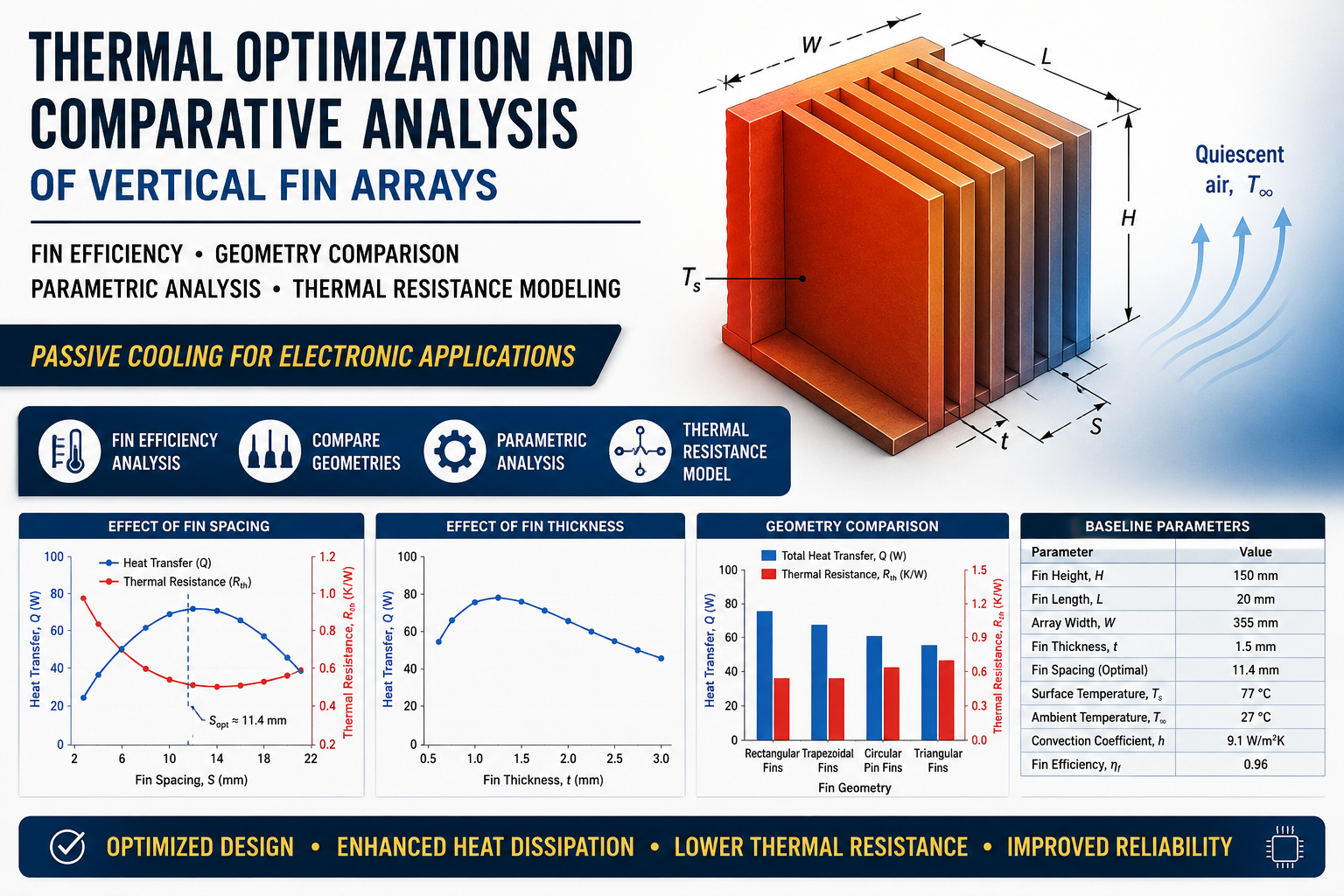
Passive cooling using extended surfaces is a widely used thermal management method for electronic devices because it requires no external power and has high reliability. This article develops an extended thermal analysis of a vertical fin array subjected to natural convection in quiescent atmospheric air. The original fin-array problem is modified by including fin efficiency analysis, comparison of alternative fin geometries, parametric investigation of fin spacing and thickness, and thermal resistance network modeling. Four geometries are considered: rectangular plate fins, triangular tapered fins, trapezoidal tapered fins, and circular pin-fin equivalents. A Python-based computational model is used to calculate the Rayleigh number, Nusselt number, convection coefficient, fin efficiency, total heat transfer rate, and thermal resistance. For the baseline aluminum fin array, the optimum spacing is approximately 11.36 mm, and the rectangular plate-fin configuration provides the largest heat dissipation, approximately 69.84 W, with a thermal resistance of 0.716 K/W. The results show that geometry and spacing strongly affect passive heat-sink performance, and that thermal resistance modeling provides a direct design metric for electronic cooling applications

Read More Download PDF
Thermal Analysis of Vertical Rectangular Fin Arrays Under Natural Convection Cooling
Renewable Energy

Thermal Analysis of Vertical Rectangular Fin Arrays Under Natural Convection Cooling

Renjith R, Rajesh P Nair

2026-05-09

Passive cooling using extended surfaces is a widely used thermal management method for electronic devices because it requires no external power and has high reliability. This article develops an extended thermal analysis of a vertical fin array subjected to natural convection in quiescent atmospheric air. The original fin-array problem is modified by including fin efficiency analysis, comparison of alternative fin geometries, parametric investigation of fin spacing and thickness, and thermal resistance network modeling. Four geometries are considered: rectangular plate fins, triangular tapered fins, trapezoidal tapered fins, and circular pin-fin equivalents. A Python-based computational model is used to calculate the Rayleigh number, Nusselt number, convection coefficient, fin efficiency, total heat transfer rate, and thermal resistance. For the baseline aluminum fin array, the optimum spacing is approximately 11.36 mm, and the rectangular plate-fin configuration provides the largest heat dissipation, approximately 69.84 W, with a thermal resistance of 0.716 K/W. The results show that geometry and spacing strongly affect passive heat-sink performance, and that thermal resistance modeling provides a direct design metric for electronic cooling applications

Read Article PDF Cite